







Custom Printed Table Covers
Check your design
Your file on the size you picked
Sides
Size
Orientation
Position
Drag the design to move it. Anything outside the red dashed line is trimmed off.
Background (empty space)

Custom Printed Table Covers
Custom Printed Table Covers
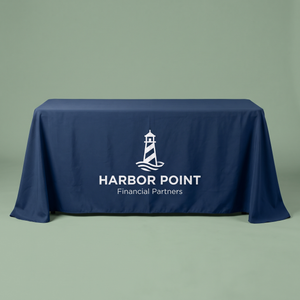
A printed cover turns a bare folding table into a finished stand, and it packs into a bag at the end of the day. Dye sublimated into 8.8 oz polyester table fabric, full colour across the whole panel, sewn with rounded corners and hemmed edges, cut to fit 4 ft, 6 ft and 8 ft tables.
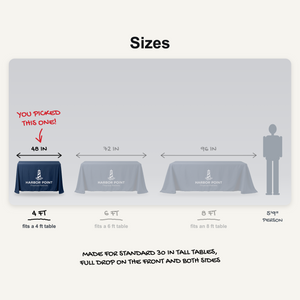
- Three lengths, cut for standard 48″, 72″ and 96″ display tables, all 30″ high and 30″ deep
- 8.8 oz polyester table fabric, hemmed edges, rounded corners, hangs about 2″ above the floor
- Dye sublimation, so the colour sits in the fibres instead of on top of them
- Open back or closed back, depending on whether you work from behind the table
- Full colour edge to edge, not a logo patch on a blank cloth
- Ships the next business day when your artwork is approved before 4pm PT
Pick the length before anything else
Table covers are cut to fit, so length is the one thing you cannot adjust later. Measure the table you will actually be standing behind, or get the size in writing from the venue. Plenty of exhibition halls hand out 6 ft tables as standard and only supply 8 ft on request, and a lot of registration desks and small booths are 4 ft.
- 4 ft, for a 48″ table. Registration desks, sampling stations, small booths, and the folding table most people already own.
- 6 ft, for a 72″ table. The default at most venues and the size ordered most often. If you are buying one cover and you do not know what the venue will give you, buy this one.
- 8 ft, for a 96″ table. Eight feet of unbroken branded frontage. It reads from across a hall in a way a 6 ft table does not, and it is the usual banquet and larger booth size.
All three are cut for a table 30″ high and 30″ deep, which is the standard folding table. A cover made for a shorter table leaves the legs showing, and one made for a longer table bunches at the corners and never hangs straight.
Open back or closed back
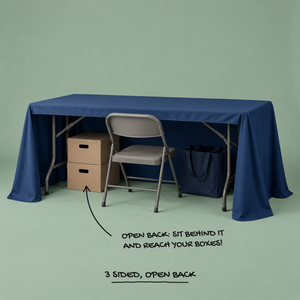
- 3 sided, open back. The front and both ends are covered and the back is left open. This is the practical choice for a staffed table. You can sit at it, get your legs underneath, and reach boxes and stock stored below without lifting fabric out of the way every time.
- 4 sided, closed back. All four sides enclosed. Choose it when the table stands in the open, when visitors walk all the way round it, or when you want everything stored underneath completely out of sight. The trade off is that getting to that storage means lifting the back panel.
The two are cut differently, not just finished differently, so the artwork area is a different shape for each. Decide which one you want before you start designing.
Why the fabric and the print method matter
Dye sublimation uses heat to turn the ink into a gas that bonds with the polyester fibres. The colour ends up inside the fabric rather than as a layer on the surface, which is why there is nothing to crack, peel or flake off at the fold lines. The cover stays soft, it drapes instead of standing stiff, and it is fully washable, so it survives being folded into a bag, thrown in a car, and cleaned between events.
The 8.8 oz weight is the part people notice in person. It hangs straight and holds its shape instead of billowing every time somebody walks past, and it has enough body that the cover looks deliberate rather than like a sheet thrown over a table. The corners are sewn round rather than square, so it sits on the table without a stiff point sticking out at each end.
Setting up your artwork
These covers print from a single flat file built to the finished panel, and the setup is not the same as a business card or a flyer. The three rules people get wrong most often:
- No crop marks and no bleed. Large format fabric is cut to the template, not trimmed down, so a file with bleed on it comes out wrong. Build to the size and stop there.
- 150 dpi is the target, not 300. A 150 dpi file at this physical size is already enormous and is plenty for fabric. Chasing 300 dpi gives you a file that is four times the size for no visible gain.
- CMYK, with fonts outlined. Pantone and spot colours have to be converted to CMYK before you send the file, and live fonts should be converted to outlines so nothing reflows.
Send a single page PDF or a JPEG, up to 300MB. We check every file before it goes to print and come back to you if anything needs changing. If you are not sure, send it anyway and we will tell you.
Designing a table cover that works
The front drop is the part everyone sees, and the bottom third of it is hidden for most of the day by chairs, bags, legs and visitors standing at the table. Put the logo and the business name in the upper half and leave the bottom quiet.
Keep the wording short. Nobody reads a paragraph on fabric at knee height. A name, what you do in three or four words, and a web address is the whole job. Detail belongs on a table tent card on the tabletop, or on a tabletop banner at eye level.
Remember that the top of the table disappears under product, literature and a card reader for the whole event, so anything printed in the middle of the tabletop area is wasted. And resist tiling the logo across the full width. One confident, well scaled mark reads as more established than a repeating pattern.
What to use it with
The table is the one surface every visitor stands directly in front of, which is why a printed cover does more per dollar than most display hardware. It takes no floor space, there is nothing to assemble, and there is nothing to knock over.
The setups that work hardest pair it with something vertical. A pull-up banner behind you carries the message people read from the aisle, and a feather flag outdoors pulls people toward the stand in the first place. The cover then carries the identity people read while they are standing talking to you.
Care and storage
Machine wash cold on a gentle cycle, then lay flat or hang to dry. Do not bleach, do not tumble dry, and do not iron it. Heat is what fixed the colour into the fabric in the first place, and an iron is the one household thing hot enough to damage it.
Creases and wrinkles come out with a hand steamer, and light creasing drops out on its own within an hour of the cover being stretched over a table. Fold it loosely between events and change where the folds land so you do not set a permanent line in the same place.
Specs at a glance
- Material: 8.8 oz polyester table fabric, hemmed edges, rounded corners
- Printing: full colour dye sublimation
- Fits: 48″ × 30″ × 30″ (4 ft) · 72″ × 30″ × 30″ (6 ft) · 96″ × 30″ × 30″ (8 ft)
- Finished size, 3 sided open back: 102″ × 62.25″ · 126″ × 62.25″ · 150″ × 62.25″
- Finished size, 4 sided closed back: 102″ × 83.5″ · 126″ × 83.5″ · 150″ × 83.5″
- Weight: 4 to 5.4 lbs open back, 5.5 to 7.3 lbs closed back, depending on length
- Drop: hangs approximately 2″ above the floor
- Artwork: single page PDF or JPEG, CMYK, 150 dpi, up to 300MB, no crop marks, no bleed
- Production: ships next business day when artwork is approved before 4pm PT. Over 100 covers adds 2 business days.
- Care: machine wash cold, hang or lay flat to dry, steam only
Table cover FAQ
Fit, construction, artwork and care answers are below. Table tent cards sit on top of the cover, and a tabletop pull-up banner adds height without taking any floor space.

Files are checked before production.
Approval requirements appear with the order.
Return to the products your business uses.
Support when your artwork is not ready.
Everything clear before you order.
Every order gets a free file review before printing. Here's what to know about specs, artwork, proofing, and delivery.
Specifications
Price break: 1–9, 10+. Configuration: 4 ft · 3 sided (Open-back), 4 ft · 4 sided (Close-back), 6 ft · 3 sided (Open-back), 6 ft · 4 sided (Close-back), 8 ft · 3 sided (Open-back), 8 ft · 4 sided (Close-back)
Artwork requirements
Upload print-ready files as PDF (preferred), AI, EPS, JPG, or PNG at 300 DPI in CMYK color. Extend backgrounds 0.125" past the trim edge (bleed) and keep text and logos at least 0.125" inside it (safe area). Every file is checked by our team before production — if something's off, we'll contact you before anything prints.
Proofing and production
Production time starts after your artwork passes file review — not at checkout. If your order requires proof approval, we'll send the proof and the production clock starts once you approve it. Turnaround options for each product are shown in the configurator above.
Shipping and delivery
Delivery time is production time plus transit. Once your order ships you'll get a tracking number by email. Transit depends on your address and the shipping method selected at checkout — larger format items may ship separately from small-format printing.
BEFORE YOU ORDER
Not sure which option to pick?
These guides use our own real specs and prices, not general advice.
From options to production
-
01
Choose the product
Select the specifications and quantity that fit your project.
-
02
Add your artwork
Upload a finished file, use a template or request design help.
-
03
Review when required
Approve the proof when the selected workflow requires it.
-
04
Production & delivery
Production begins after required files and approvals are complete.
Products that work well together

Yard Signs
4mm coroplast yard signs — the workhorse of local advertising, weatherproof and ready to stake in...
View product →
Standard Business Cards
The card every business starts with. Standard business cards on sturdy 14pt cardstock — crisp ful...
View product →
Car Magnets
Turn any vehicle into a rolling billboard. Car magnets print on heavy-duty 30mil magnetic stock —...
View product →
Premium High-Gloss Business Cards
The flashiest card in the lineup. Premium high-gloss business cards combine heavyweight 16pt stoc...
View product →What real customers say
Verified feedback from customers who ordered this product.


More ways to make it personal
Yard Signs
4mm coroplast yard signs — the workhorse of local advertising, weatherproof and ready to stake in...
View product →
Standard Business Cards
The card every business starts with. Standard business cards on sturdy 14pt cardstock — crisp ful...
View product →
Car Magnets
Turn any vehicle into a rolling billboard. Car magnets print on heavy-duty 30mil magnetic stock —...
View product →
Premium High-Gloss Business Cards
The flashiest card in the lineup. Premium high-gloss business cards combine heavyweight 16pt stoc...
View product →
Foam Board Signs
Foam board signs give you a perfectly flat, lightweight display panel with a smooth photographic ...
View product →
Custom Round Table Covers
Round tables are where people actually stand and talk. Cocktail tables at a launch, rounds at a f...
View product →Helpful before you order
Answers about artwork, production and ordering.
Should I choose a 3-sided or 4-sided table cover?
3-sided (open back) is the practical choice for staffed tables — you can sit at the table, get your legs under it and reach stock stored underneath. 4-sided (closed back) encloses all four sides, which is right when the table stands in the open, people walk behind it, or you want everything underneath hidden.
How do I make sure I order the right table size?
Measure the table you will actually use, or confirm in writing with the venue — many halls supply 6 ft as standard and only provide 8 ft on request. A cover that is too short leaves the legs exposed; one that is too long puddles on the floor. If you exhibit at venues with both, owning one of each is worth it.
How should I set up artwork for a table cover?
Send a single page PDF or a JPEG, up to 300MB, in CMYK at 150 dpi. Build the file to the finished panel size with no crop marks and no bleed, because fabric this size is cut to the template rather than trimmed down. Convert any Pantone or spot colours to CMYK and convert live fonts to outlines. 300 dpi is not needed at this physical size and only gives you a file four times larger. We check every file before it prints and come back to you if anything needs changing.
What does dye sublimation mean for a table cover?
The design is printed with heat, which turns the ink into a gas that bonds with the polyester fibres. The colour ends up inside the fabric instead of sitting on top of it as a layer, so there is nothing to crack, peel or flake off along the fold lines. The cover stays soft, it drapes properly rather than standing stiff, and the print survives being folded into a bag and washed between events.
How fast can I get a printed table cover?
Covers go into production the next business day when artwork is approved before 4pm Pacific, and shipping time sits on top of that depending on the service you choose at checkout. If you are working to a fixed event date, order with a few days of slack. The artwork check is where most delays start, and a file that needs changing costs a day.
How do I wash and store a printed table cover?
Machine wash cold on a gentle cycle, then lay flat or hang to dry. Do not bleach, do not tumble dry, and do not iron it. Heat is what fixed the colour into the fabric, and an iron is the one household thing hot enough to damage the print. Creases come out with a hand steamer, and light creasing drops out on its own within an hour of the cover being stretched over a table. Fold loosely between events and vary where the folds land so you do not set a permanent line.